An industrial packaging machine passes factory testing. The control cabinet looks organized, servo motors run smoothly, sensors respond correctly and the machine ships on time. After weeks of real production, the customer reports random sensor faults, servo alarms, damaged drag chain cables, loosened connectors, unstable vision camera signals and confusing cable labels. The problem is not only the PLC program or machine layout. The cable assembly design did not fully match the real industrial environment.
A Custom Cable Assembly is not just a cable with connectors. In industrial equipment, it affects uptime, signal reliability, machine safety, maintenance speed, installation efficiency and long-term OEM supply stability. A professional Custom Cable Assembly manufacturer should understand equipment function, cable role, current load, connector system, shielding, routing, flex life, testing and documentation before recommending a design.
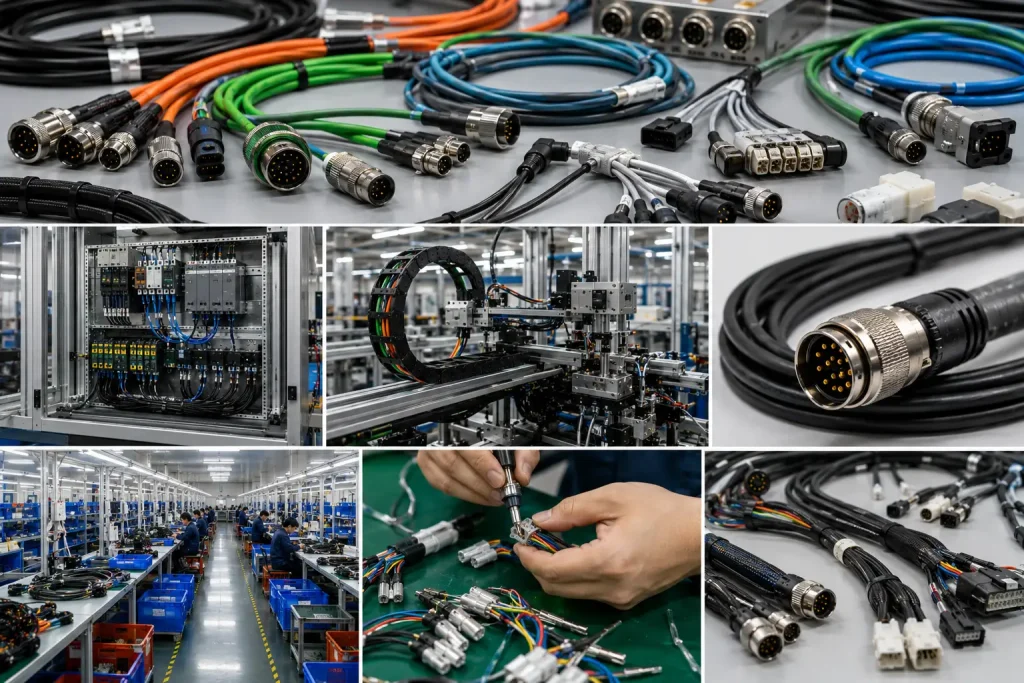
Why Custom Cable Assembly Design Matters in Industrial Equipment
Industrial equipment operates under conditions that are much tougher than normal office or consumer electronics environments. A cable assembly may face vibration, oil mist, coolant, dust, water splash, repeated motion, EMI from servo drives, temperature variation, cable drag, frequent maintenance and long production hours. A generic cable may work during a short trial, but fail after months of factory use.
Industrial buyers should evaluate a Custom Cable Assembly by function, environment and maintenance logic. A power cable needs current capacity and terminal strength. A sensor cable needs pinout accuracy and IP protection. A servo cable needs shielding and vibration resistance. A drag chain cable needs flex life and bend-radius control. A vision cable needs data stability. Buyers can contact a Custom Cable Assembly supplier with drawings, connector models, cable route, environment, testing needs and annual volume to receive a more accurate technical recommendation.
| Selection Area | Industrial Equipment Risk | Buyer Should Confirm | Supplier Proof |
|---|---|---|---|
| Power cable assembly | Heating and voltage drop | Current rating, wire gauge, terminal quality | Cable datasheet and test record |
| Signal cable assembly | False signals and instability | Shielding, pinout, connector lock | Continuity and functional test |
| Data cable assembly | Network dropout | Cable category, shielding, route | Network cable test |
| Drag chain cable | Broken conductors | Bend radius, flex rating, jacket material | Flex cable specification |
| Sensor cable | Wrong input/output signal | M8/M12 pinout and IP rating | 100% continuity test |
| EMI protection | Random machine fault | Shielding, grounding, separation | Shield continuity record |
What Is a Custom Cable Assembly?
Definition for Industrial Equipment Buyers
A Custom Cable Assembly is a purpose-built cable solution that combines cable, wire, connectors, terminals, contacts, sleeves, labels, strain relief, shielding, overmolding, protective jackets or branch structures according to a specific equipment design. It is used when a standard off-the-shelf cable cannot fully meet the machine’s electrical, mechanical, environmental or service requirements.
In industrial equipment, custom cable assemblies may connect servo motors, encoders, sensors, PLC modules, remote I/O modules, cameras, industrial Ethernet devices, solenoid valves, actuators, control panels, power supplies, safety devices, robotic axes, drag chains and machine vision systems.
Custom Cable Assembly vs Wire Harness
| Factor | Custom Cable Assembly | Wire Harness |
|---|---|---|
| Structure | Usually cable with connectors, shielding or jacket | Multiple wires bundled into a routing system |
| Main use | Device-to-device connection | Internal wiring organization |
| Common form | M8/M12 cable, servo cable, Ethernet cable, power cable | Cabinet harness, machine harness, vehicle harness |
| Design focus | Cable type, connector, shielding, environment | Routing, branch points, wire grouping |
| Testing focus | Continuity, insulation, shield, signal, function | Continuity, pinout, label and assembly accuracy |
Step 1: Define the Equipment Function and Cable Role
Power Signal Data or Motion Cable
Before choosing connector type, jacket material or cable length, buyers must define the cable’s role. A power cable assembly, servo motor cable assembly, encoder cable assembly, sensor cable assembly, industrial Ethernet cable assembly, vision camera cable assembly, PLC cable assembly, safety circuit cable, valve cable assembly and drag chain cable assembly all need different engineering logic.
The cable role determines wire gauge, shielding, connector locking, route protection, test method and maintenance labeling. A sensor cable that only carries a digital input does not need the same design as a servo motor power cable. A drag chain cable cannot be selected like a static cabinet cable. A vision camera cable needs data stability, not only physical connection.
| Cable Role | Main Requirement | Buyer Risk |
|---|---|---|
| Power cable | Current rating and temperature rise | Heating or voltage drop |
| Servo cable | Shielding and motor-side vibration | EMI and motor fault |
| Encoder cable | Signal integrity | Position error |
| Sensor cable | Correct pinout and IP rating | False machine signal |
| Ethernet cable | Bandwidth and shielding | Network dropout |
| Drag chain cable | Flex life and bend radius | Broken conductor |
| Safety cable | Reliable connection | Safety circuit interruption |
Step 2: Choose Cable Type and Electrical Rating
Voltage Current and Wire Gauge
Power-related cable assemblies should be selected by rated voltage, continuous current, peak current, cable length, voltage drop limit, ambient temperature, bundle condition, connector current rating, terminal material, application duty cycle and safety margin. Cable size should not be selected by appearance or previous project habit. It should be selected by load, route and temperature.
If a cable is undersized, it may create voltage drop and heat. If a terminal is poorly matched, the connection point may heat even when the cable conductor is acceptable. If the cable is too stiff, installation may stress the connector. If the route is too long, voltage drop can affect machine performance. Electrical selection and mechanical route planning should be reviewed together.
Power Cable Design Checklist
| Design Parameter | Why It Matters | Buyer Check |
|---|---|---|
| Wire gauge | Controls heat and voltage drop | Match current and cable length |
| Rated voltage | Supports insulation safety | Match equipment voltage |
| Conductor material | Affects resistance and flexibility | Confirm copper type and strand structure |
| Terminal type | Controls connection quality | Match connector and current |
| Contact resistance | Prevents local heating | Request test method if critical |
| Cable length | Affects voltage drop and routing | Confirm tolerance |
| Temperature rating | Supports equipment environment | Check cable datasheet |
Step 3: Connector Selection for Industrial Equipment
M8 M12 Circular Connectors Terminal Blocks and Custom Connectors
Common industrial connector options include M8 connectors, M12 connectors, circular aviation connectors, servo motor connectors, RJ45 industrial connectors, D-sub connectors, terminal block connectors, waterproof connectors, overmolded connectors, panel-mount connectors and custom plug-and-socket solutions.
Connector selection should consider rated voltage, rated current, pin count, pinout, locking method, IP rating, mating cycles, coding, keying, cable exit direction, shield termination, field service needs, vibration resistance, chemical exposure and temperature rating. The connector should not only fit electrically. It should also survive machine installation and maintenance.
Connector Selection Factors
| Connector Type | Best Use | Buyer Risk |
|---|---|---|
| M8 connector | Compact sensors | Pinout mismatch |
| M12 connector | Sensors, IO-Link, Ethernet | Wrong coding or IP rating |
| Servo connector | Motor power and feedback | EMI and vibration |
| Industrial RJ45 | Ethernet communication | Weak locking or shielding |
| Terminal block | Cabinet wiring | Loose wire or wrong label |
| Waterproof connector | Wet or dusty equipment | Seal failure |
Step 4: Shielding Grounding and EMI Protection
Why Industrial Cable Assemblies Need EMI Planning
Industrial equipment may include servo drives, VFDs, motors, switching power supplies, solenoids, welders, heaters and long cable routes. These components can create electrical noise that causes random PLC input faults, servo alarms, encoder errors, sensor instability, camera image noise, Ethernet dropout, false safety alarms and commissioning delays.
EMI problems are often difficult to diagnose because they may not appear continuously. The machine may run normally for hours and then suddenly alarm under certain speed, load, temperature or routing conditions. Good cable assembly design reduces these hidden risks by considering shielding, grounding and route separation early.
Shielded Cable Assembly Design
Shielded cable assembly design may include braid shielding, foil shielding, drain wire, twisted pairs, 360-degree shield termination, metal connectors, grounding strategy, power/signal separation, shield continuity testing and cable route documentation. A cable can look shielded but perform poorly if the shield is not properly terminated.
Step 5: Jacket Material and Environmental Resistance
Oil Water Heat Abrasion and Chemicals
Industrial cable assemblies may be exposed to oil mist, coolant, grease, water spray, cleaning chemicals, dust, metal chips, heat and abrasion. Cable jacket material should be selected by the actual machine environment. A material that works inside a dry cabinet may not work near cutting fluids, washdown zones or moving machine parts.
| Environment | Material Risk | Recommended Direction |
|---|---|---|
| Oil/coolant | Jacket swelling or cracking | Oil-resistant PUR/TPE |
| Repeated motion | Conductor fatigue | High-flex cable |
| Heat | Insulation aging | Silicone/PTFE where suitable |
| Abrasion | Jacket damage | Sleeve or conduit |
| Water/dust | Connector ingress | IP-rated connectors |
| Cleaning chemicals | Jacket degradation | Chemical-resistant material |
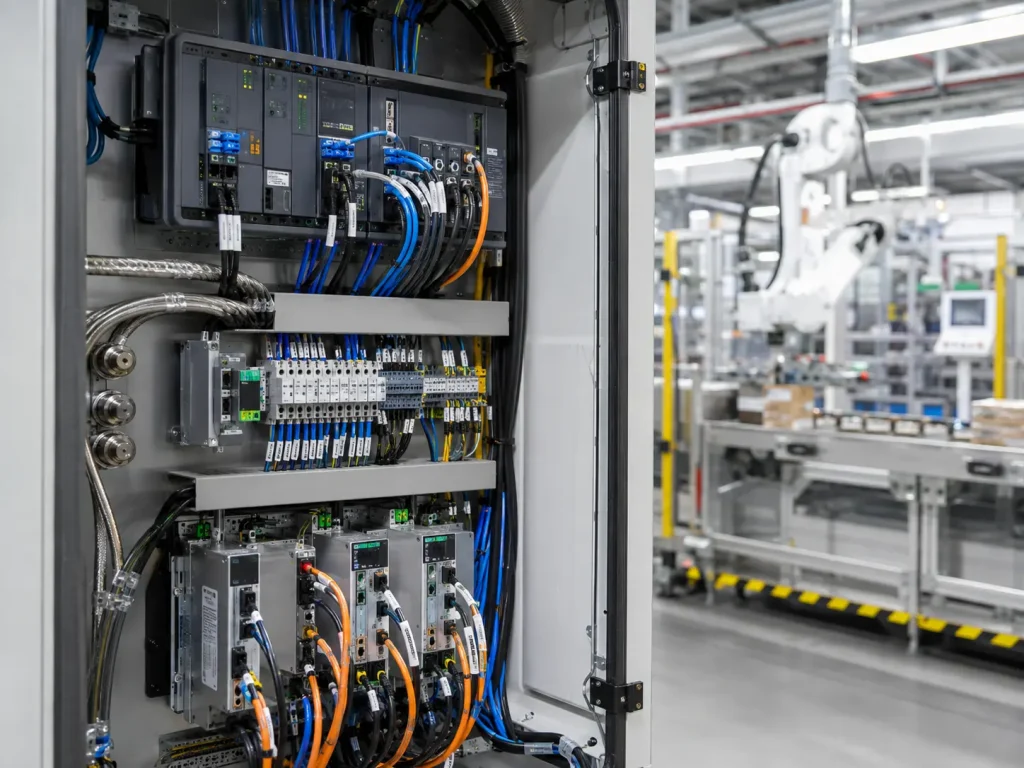
Step 6: High-Flex and Drag Chain Cable Assembly Design
Why Ordinary Cable Fails in Motion
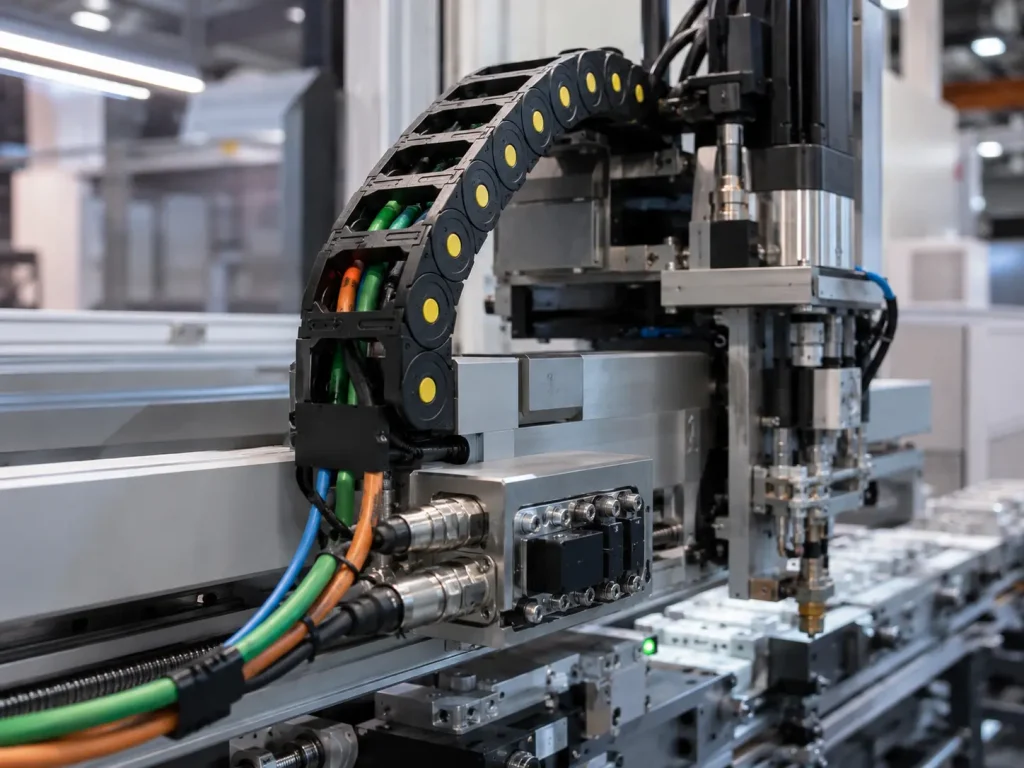
Drag chains, moving gantries, robotic axes, pick-and-place systems and linear modules require dynamic cables. Ordinary cable can fail because of conductor fatigue, jacket cracking, twisting, tight bend radius, incorrect chain fill or connector stress. The failure may first appear as intermittent faults before the conductor fully breaks.
In real industrial production, intermittent cable failure is expensive. It may stop the machine randomly, confuse maintenance teams and create unnecessary replacement of sensors, drives or PLC modules. A correct high-flex cable assembly can reduce this downtime risk.
Flex Cable Selection Rules
| Motion Parameter | Why It Matters | Buyer Check |
|---|---|---|
| Bend radius | Controls conductor fatigue | Match cable datasheet |
| Stroke length | Affects cable movement | Confirm machine route |
| Cycle life | Predicts service life | Define duty cycle |
| Jacket material | Resists abrasion | Select flex-rated PUR/TPE |
| Cable diameter | Controls chain fit | Avoid overfill |
| Connector exit | Prevents stress | Add strain relief |
Step 7: Industrial Ethernet and Machine Vision Cable Assemblies
PROFINET EtherNet/IP EtherCAT and IO-Link Cables
Industrial data cables require more than basic network function. They must support bandwidth, shielding, connector locking, bending, EMI control and industrial environmental stress. Common industrial protocols and data systems may include PROFINET, EtherNet/IP, EtherCAT, Modbus TCP, IO-Link, RS485, CANopen, USB3 Vision, GigE Vision and Camera Link.
For machine builders, a poor industrial Ethernet cable assembly can create intermittent network dropouts that are difficult to reproduce. Good cable selection should consider cable category, shield structure, connector lock, bend radius, route separation and testing.
Vision Camera Cable Requirements
Machine vision applications require stable image data and trigger timing. Buyers should check cable bandwidth, data stability, trigger signal timing, shielding, connector locking, flex rating, route separation, lighting cable separation, strain relief and functional data testing. A camera cable that works on a bench may fail if it is repeatedly bent near a moving vision station.
Step 8: Labeling Routing and Serviceability
Why Labels Reduce Machine Downtime
Industrial equipment requires maintenance. Cable labels should match drawings, PLC I/O points, sensor names, motor axis numbers and cabinet terminal numbers. When labels are clear, technicians can replace a sensor cable, motor cable or Ethernet cable faster. When labels are weak, troubleshooting time increases and mistakes become more likely.
Labeling is especially important for repeated OEM machines. If every machine uses the same label structure, service teams can diagnose issues faster across different installations. Good labeling also helps spare part management and repeat orders.
Good Labeling Practice
Good labeling may include wire number, cable ID, device name, axis number, connector code, signal type, revision number where needed, heat-shrink label, printed sleeve, durable marking and drawing-matched identification. Labels should remain readable after handling, cleaning, vibration and normal machine use.
Step 9: Testing and Quality Control for Custom Cable Assemblies
Electrical Testing
Common electrical tests include continuity, open/short testing, miswire testing, polarity testing, hi-pot testing, insulation resistance testing, contact resistance testing, shield continuity testing, network cable testing, functional testing, servo feedback testing and sensor signal testing. The exact test plan should match cable function and machine risk.
Mechanical and Process Testing
Mechanical and process checks may include crimp height, crimp cross-section, pull force, terminal retention, connector mating, bend testing, drag chain simulation where required, vibration testing where required, waterproof testing where required, visual inspection, label inspection, length tolerance and packing inspection.
| Test | Purpose | Buyer Value |
|---|---|---|
| Continuity | Confirms circuit path | Prevents wiring errors |
| Miswire test | Confirms pinout | Reduces commissioning delay |
| Hi-pot | Checks insulation | Supports safety circuits |
| Shield continuity | Confirms EMI path | Reduces signal faults |
| Pull force | Confirms crimp strength | Reduces field failure |
| Functional test | Simulates device signal | Catches hidden faults |
| Flex test | Checks motion cable life | Reduces drag chain failure |
| Label inspection | Confirms service logic | Improves maintenance speed |
Step 10: Standards Documentation and Compliance
Industrial Cable Assembly Standards and References
Industrial cable assembly projects may reference IPC/WHMA-A-620 for cable and wire harness workmanship expectations, IEC 60204-1 for machinery electrical equipment, NFPA 79 for industrial machinery electrical requirements, UL 508A where control panels are involved, ISO 9001 for quality management, RoHS/REACH material declarations and customer-specific automation requirements.
The cable assembly alone does not certify the machine. It supports machine-level compliance, but the complete equipment, control system and installation must be evaluated together. Strong cable assembly documentation helps buyers verify what was built, tested and shipped.
Supplier Documentation Package
A complete supplier documentation package may include cable assembly drawing, BOM, wire list, pinout table, cable datasheets, connector datasheets, shielding diagram, grounding plan, labeling standard, inspection report, continuity test record, hi-pot record, insulation resistance record, shield continuity record, pull force report, first article inspection, traceability record, packing photos, revision history and engineering change record.
Step 11: Supplier Selection and RFQ Checklist
What a Custom Cable Assembly Supplier Should Provide
A reliable supplier should provide engineering review, cable and connector sourcing, crimping, soldering where required, overmolding where required, shielded cable termination, servo cable assembly, sensor cable assembly, Ethernet cable assembly, drag chain cable experience, oil-resistant cable selection, continuity testing, hi-pot testing, shield continuity testing, functional testing, labeling, traceability, prototype support, mass production and failure analysis.
Buyer RFQ Checklist
| RFQ Item | Why It Matters | Buyer Requirement |
|---|---|---|
| Equipment type | Controls application risk | Packaging, CNC, robot, conveyor, vision, test or automation equipment |
| Cable function | Controls electrical and mechanical design | Power, signal, data, motion, safety or sensor cable |
| Connector part numbers | Controls mating and availability | M8, M12, servo, RJ45, terminal or custom connector |
| Cable route | Controls length, bend radius and protection | Static, moving, drag chain, under panel or field device route |
| Environment | Controls jacket and connector choice | Oil, water, dust, heat, vibration, chemicals or abrasion |
| Testing | Controls quality confidence | Continuity, hi-pot, shield, network, signal, flex or functional tests |
Common Buyer Mistakes
Mistake 1: Treating Custom Cable Assemblies Like Standard Cables
Standard cables may not match equipment function, connector locking, route protection, oil exposure, EMI risk or maintenance needs. Buyers should define application, environment, route and test requirements before selecting a cable assembly.
Mistake 2: Ignoring EMI and Shielding
Uncontrolled EMI can cause servo alarms, encoder faults, sensor instability and network dropout. Buyers should use shielded cable, proper grounding and route separation where needed.
Mistake 3: Using Static Cable in Moving Applications
Static cable may break internally in drag chains, robotic axes and moving gantries. High-flex cable, correct bend radius and connector strain relief should be selected for dynamic motion.
Mistake 4: Weak Labels and Poor Documentation
Poor labels make maintenance slower and increase wiring mistakes. Cable ID, wire number, device name, connector code and drawing-matched identification should be planned before production.
Mistake 5: Buying Only by Lowest Unit Price
Low unit price can hide weak materials, poor shielding, incomplete testing, short flex life and missing traceability. The real cost appears as downtime, warranty claims, delayed commissioning and customer complaints.
Industry Trends in Custom Cable Assembly Design
More Industrial Equipment Uses Modular Cable Assemblies
Machine builders increasingly use modular cable assemblies to reduce wiring time and improve repeatability. Pre-built cables can make machine assembly faster and reduce manual wiring mistakes.
Servo and Motion Systems Require Better Shielding
Motion control systems increase demand for shielded, oil-resistant and vibration-resistant cable assemblies. Servo drives, encoders and motor cables need better route planning and EMI control.
Drag Chain Cable Life Is Becoming a Purchasing Factor
Buyers increasingly ask for flex-life and bend-radius data. A cable assembly used in motion should be selected by duty cycle, stroke length and mechanical route, not only connector type.
Industrial Ethernet Raises Data Cable Requirements
Machine vision and real-time networks require stable data cable assemblies. Cable bandwidth, shielding, connector locking and bending performance are becoming more important.
Buyers Expect More Documentation and Traceability
OEM buyers increasingly request inspection reports, first article inspection, test records, packing photos and revision control. Good documentation helps repeat orders and failure analysis.
Final Recommendation: Design Cable Assemblies Around Equipment Uptime
A Custom Cable Assembly should be selected by equipment function, electrical load, signal type, data requirement, movement, environment, connector system and maintenance logic. Power cables need current rating and terminal control. Signal cables need shielding and pinout accuracy. Drag chain cables need flex life and bend radius. Sensor cables need IP rating and service labels. Data cables need bandwidth, shielding and connector locking.
Before requesting a Custom Cable Assembly quote, prepare your equipment type, cable function, voltage/current, connector part numbers, pinout, cable route, bend radius, drag chain requirement, shielding requirement, IP rating, environment, testing needs and annual volume. A professional Custom Cable Assembly supplier can help design a more reliable industrial cable solution that reduces commissioning problems and long-term equipment downtime.
Frequently Asked Questions About Custom Cable Assemblies
1. What is a Custom Cable Assembly?
A Custom Cable Assembly is a purpose-built cable solution that combines cable, connectors, terminals, contacts, shielding, labels, strain relief, sleeves, protective jackets or overmolding according to a specific equipment design. In industrial equipment, it may connect motors, sensors, PLC modules, cameras, Ethernet devices, valves, power supplies, safety devices and moving machine axes. A well-designed Custom Cable Assembly improves installation speed, signal reliability, machine uptime and maintenance efficiency.
2. What is the difference between a Custom Cable Assembly and a Wire Harness?
A Custom Cable Assembly usually focuses on cable-to-device connection, such as servo cables, M8/M12 sensor cables, industrial Ethernet cables, power cables or drag chain cables. A wire harness usually organizes multiple wires or branches inside equipment, control cabinets or vehicles. The two can overlap, but cable assemblies often focus more on cable type, connector selection, shielding, jacket material, route environment and functional testing.
3. What cable assembly is best for industrial equipment?
The best cable assembly for industrial equipment depends on the cable function, electrical load, signal type, data requirement, movement, environment, connector system and maintenance needs. Power cables should prioritize current rating and temperature rise. Sensor cables should prioritize pinout and IP rating. Drag chain cables should prioritize flex life and bend radius. Data cables should prioritize bandwidth, shielding and connector locking. There is no single best cable assembly for every machine.
4. How do you design a cable assembly for drag chains?
To design a cable assembly for drag chains, use high-flex cable, confirm minimum bend radius, define stroke length, estimate duty cycle, select abrasion-resistant jacket material, avoid chain overfill, control cable separation and add connector strain relief. Static cables should not be used in repeated-motion applications because conductors may fatigue internally. Buyers should review flex cable specifications and machine routing before approving production.
5. How do I choose a Custom Cable Assembly manufacturer?
Choose a Custom Cable Assembly manufacturer with engineering review capability, connector sourcing, crimping process control, shielded cable termination, servo cable experience, sensor cable experience, industrial Ethernet cable experience, drag chain cable knowledge, testing capability, labeling control, traceability, prototype support and mass production capacity. A reliable supplier should ask about equipment function, environment, route, connector, shielding, testing and annual volume before quoting.
References
- IPC/WHMA-A-620F Requirements and Acceptance for Cable and Wire Harness Assemblies, Author: IPC and WHMA Technical Committee, Institution: IPC International and Wiring Harness Manufacturer’s Association, Source: Cable and Wire Harness Assembly Standard.
- IEC 60204-1 Safety of Machinery – Electrical Equipment of Machines, Author: IEC Technical Committee Contributors, Institution: International Electrotechnical Commission, Source: Machinery Electrical Equipment Standard.
- NFPA 79 Electrical Standard for Industrial Machinery, Author: NFPA Technical Committee, Institution: National Fire Protection Association, Source: Industrial Machinery Electrical Standard.
- UL 508A Standard for Industrial Control Panels, Author: UL Standards Technical Committee, Institution: UL Standards & Engagement, Source: Industrial Control Panel Standard.
- ISO 9001 Quality Management Systems Requirements, Author: ISO Technical Committee Contributors, Institution: International Organization for Standardization, Source: Quality Management System Standard.
- Industrial Ethernet Installation and Cabling Guidance, Author: Industrial Automation Technical Contributors, Institution: Automation and Control Engineering Publications, Source: Industrial Network Cabling Reference.
- Servo Drive Cable and Encoder Signal Application Guidance, Author: Motion Control Engineering Contributors, Institution: Industrial Motion Control Publications, Source: Servo System Wiring Reference.
- Machine Vision Cable and Trigger Signal Design Guidance, Author: Vision System Engineering Contributors, Institution: Industrial Machine Vision Publications, Source: Machine Vision Integration Reference.
How Buyers Should Design Custom Cable Assemblies for Industrial Equipment
How should buyers start a Custom Cable Assembly project?
Buyers should start by defining equipment type, cable function, voltage/current, connector type, pinout, cable route, movement, shielding, environment, test requirements and maintenance needs. The cable assembly should be designed as part of the machine system, not purchased as a generic cable.
Why does application environment matter?
Industrial equipment can expose cables to vibration, oil, coolant, dust, water, EMI, repeated motion and heat. The wrong cable jacket, connector or route can cause conductor breakage, false alarms, network dropout and machine downtime.
What option works best for power cable assemblies?
For power cable assemblies, buyers should prioritize wire gauge, voltage rating, current rating, contact resistance, terminal quality, cable length, insulation material and temperature-rise control.
What option works best for signal and data cable assemblies?
For signal and data cable assemblies, buyers should prioritize shielding, grounding, pinout accuracy, connector locking, route separation, cable category, functional testing and shield continuity records.
Consideration: What creates the highest cable assembly risk?
The highest risks come from treating custom cables like standard cables, ignoring EMI, using static cable in moving applications, weak labels, poor documentation and selecting suppliers only by lowest unit price.
Recommendation
Select a Custom Cable Assembly by equipment uptime value. Confirm materials, connectors, shielding, routing, flex life, testing, labels, documentation and supplier traceability before approving production.
Send your supplier the equipment layout, cable role, connector details, pinout, route, environment, shielding needs, bend radius, testing plan and annual quantity. A qualified Custom Cable Assembly supplier can recommend a safer and more production-ready design.