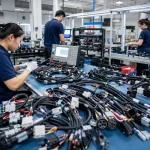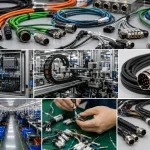
A machinery OEM designs a packaging machine, automated conveyor, pump controller, robot arm, energy storage cabinet or agricultural control system. The prototype harness works perfectly in a clean office test area. After the equipment enters a factory environment, the harness faces heat, oil mist, vibration, washdown water, dust, moving chains, motor noise and repeated maintenance handling. Three months later, a sensor line becomes unstable, one connector loosens, labels fade, and a wire jacket shows abrasion near the machine frame.
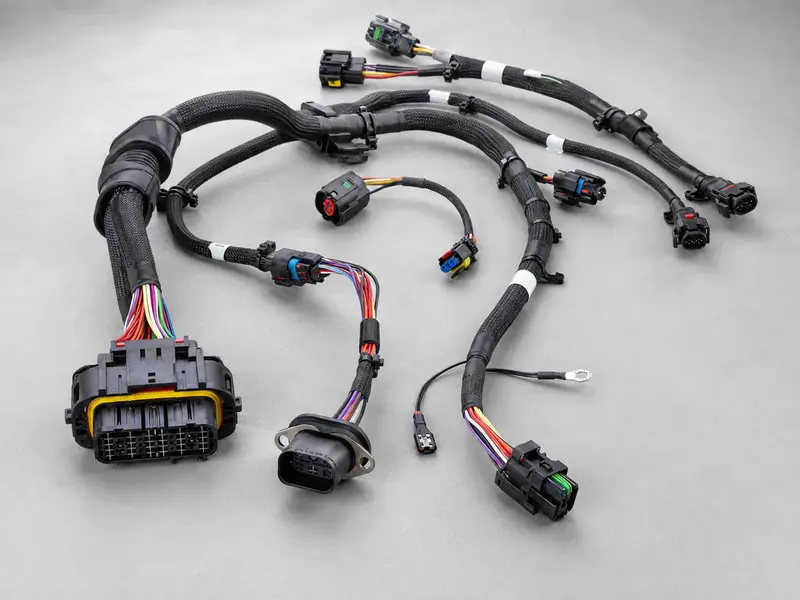
This is why an industrial Custom Wire Harness should not be purchased only by wire length, connector count or the lowest piece price. It is a reliability component that connects power, control, communication and safety-related circuits inside real machinery. A professional industrial Custom Wire Harness manufacturer should help buyers translate harsh working conditions into practical material choices, connector selections, sealing methods, protection sleeves, test requirements and repeatable production controls.
Industrial applications create different risks from consumer electronics or simple panel wiring. A control cabinet harness may need clear labeling and terminal reliability. A robot harness may need flex-rated cable and strain relief. A pump system harness may need water-resistant connectors. A conveyor harness may need abrasion protection and strong routing discipline. Before buyers request a quote, they should prepare voltage, current, environment, movement, connector part numbers, IP requirements, test methods, quantity and compliance needs. For application review, buyers can contact a Custom Wire Harness supplier with drawings, samples, machine photos and operating conditions.
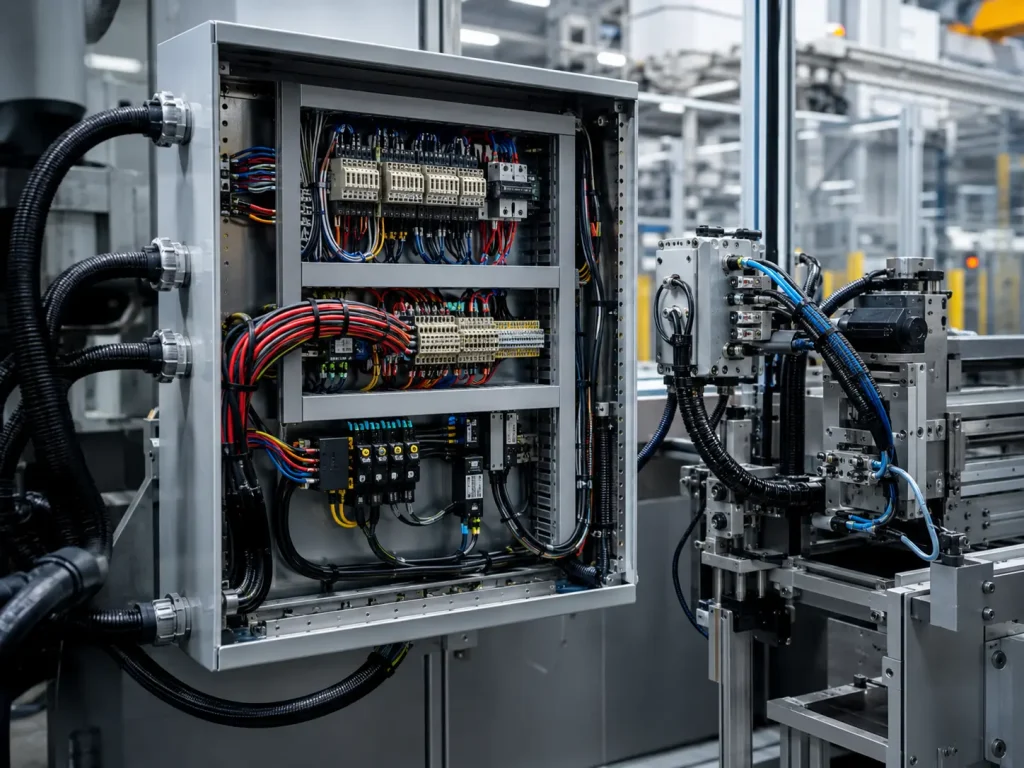
Quick Summary: Industrial Custom Wire Harness Selection Checklist
Industrial harness selection starts with the environment. A harness inside a clean electrical enclosure faces different stress than a harness installed on a vibrating machine body, moving robot arm or outdoor pump skid. The buyer must understand whether the harness is static or dynamic, dry or wet, protected or exposed, low-voltage or high-current, signal-sensitive or power-focused.
For a wider purchasing framework beyond industrial applications, OEM engineers and procurement teams can also review this Custom Wire Harness buying guide for OEM engineers and procurement teams. In industrial projects, however, the most important decision is whether the harness can survive the machine’s real environment, not only whether it can pass a basic continuity test.
| Selection Area | Industrial Risk | Buyer Should Confirm | Supplier Proof |
|---|---|---|---|
| Electrical load | Overheating or voltage drop | Current, voltage, wire gauge | Wire specification and test data |
| Environment | Heat, oil, water, dust | Temperature, IP rating, exposure | Material and connector data |
| Movement | Wire fatigue or broken conductors | Bend radius and flex cycle | Cable type and routing design |
| Vibration | Loose terminals or connectors | Locking connectors and strain relief | Pull force and retention test |
| Signal quality | Noise and false signals | Shielding and grounding | Cable structure and wiring plan |
| Compliance | Customer or market rejection | IPC, UL, RoHS, REACH where needed | Declarations and reports |
What Makes an Industrial Custom Wire Harness Different?
Industrial Harnesses Face Harsher Conditions
An industrial Custom Wire Harness often works near motors, drives, moving components, pumps, conveyors, actuators, sensors, heaters, hydraulic systems or control cabinets. These areas may expose the harness to heat, cold, oil, coolant, metal chips, vibration, dust, washdown water, UV exposure, chemical cleaners, mechanical impact and frequent maintenance handling.
A harness that works inside a consumer device may fail quickly in an industrial machine. Industrial wiring must survive both electrical and mechanical stress. The insulation must match the environment. The connector must remain locked. The crimp must remain stable. The sleeve must prevent abrasion. Labels must remain readable. The harness layout must allow service technicians to troubleshoot without damaging wires.
Common Industrial Wire Harness Applications
Industrial wire harnesses are used in automation equipment, packaging machines, CNC machines, industrial robots, conveyors, control cabinets, motor control systems, pumps, compressors, agricultural machines, construction equipment, EV charging equipment, energy storage systems, industrial lighting, sensor modules, actuators, material handling systems and food processing machinery.
Each application changes the design priority. A control cabinet wire harness needs organized routing, clear labels and terminal reliability. A robotics wire harness needs bend resistance and strain relief. A waterproof custom wire harness for outdoor equipment needs sealed connectors and cable glands. A high-temperature wire harness near heaters or motors needs proper insulation, protection sleeve and derating review.
Step 1: Define the Industrial Operating Environment
Temperature Oil Water Dust and Chemical Exposure
Before selecting wire, connector or sleeve materials, buyers should define the actual environment. The same harness may perform differently in a dry cabinet, oily machine base, outdoor pump skid, food washdown area or vibrating conveyor frame. The RFQ should not only say “industrial use.” It should describe operating temperature, maximum short-term temperature, oil contact, coolant exposure, washdown frequency, dust level, outdoor UV exposure, humidity, chemical cleaners, vibration and cable movement.
| Environment Factor | Design Impact | Buyer Question |
|---|---|---|
| High temperature | Insulation and sleeve choice | What is the maximum operating temperature? |
| Oil or coolant | Material resistance | Will the harness contact oil, grease or coolant? |
| Water or washdown | Connector sealing | What IP rating is needed? |
| Dust or particles | Connector and sleeve protection | Is the harness exposed to dust or chips? |
| Outdoor use | UV and moisture resistance | Will sunlight or rain affect the harness? |
| Vibration | Terminal and connector retention | Is the machine mobile or high-vibration? |
Static vs Dynamic Harness Routing
Static harnesses are used in control cabinets, fixed sensors, panel wiring and stationary equipment modules. They require organization, labeling, strain control and accessible service routes. Dynamic harnesses are used in robot arms, drag chains, moving doors, conveyors, sliding platforms, automated tooling and mobile equipment. They need flex-rated cable, controlled bend radius, strain relief, abrasion protection and routing away from pinch points.
If buyers treat a dynamic harness like a static cable assembly, early failure is likely. Broken conductors, cracked insulation and connector stress often come from repeated movement, tight bends and unsupported cable exits.
Step 2: Match Wire Gauge Voltage and Current Rating
Current Carrying Capacity and Voltage Drop
Wire gauge should be selected according to current, voltage, cable length, ambient temperature, bundle size, terminal compatibility and acceptable voltage drop. A wire that is large enough for current may still be too stiff for a moving assembly. A wire that is flexible enough for routing may not be suitable for heat or oil exposure. Selection should balance electrical performance, mechanical behavior and environmental resistance.
For industrial machinery, buyers should also consider peak current and continuous current separately. Motors, solenoids, heaters and actuators may draw higher startup current than steady-state current. Long harness runs can increase voltage drop, especially in low-voltage systems. High-current circuits may need larger conductors, heat-resistant insulation and stronger terminal systems.
| Industrial Load Type | Harness Concern | Selection Focus |
|---|---|---|
| Sensor signal | Noise and accuracy | Shielding and grounding |
| Low-voltage control | Stable connection | Wire gauge and terminal quality |
| Motor control line | Vibration and current | Correct conductor size |
| Power distribution | Heat and voltage drop | Current rating and insulation |
| Battery or energy system | Thermal and safety risk | High-current cable and testing |
| Data communication | Signal loss | Cable structure and routing separation |
Circuit Type Matters More Than Wire Count
A good industrial wiring plan separates power wires, signal wires, sensor wires, encoder wires, communication cables, ground wires, shield drain wires, emergency stop circuits, interlock circuits and control power circuits. Grouping wires only by voltage may create noise issues or troubleshooting confusion.
Signal lines near motors, drives or switching devices may need shielding and grounding. Emergency stop and interlock circuits may need special routing and clear identification. Maintenance technicians should be able to identify circuits quickly without guessing.
Step 3: Choose the Right Insulation and Cable Material
PVC XLPE TPE PUR Silicone PTFE and FEP
Wire insulation determines how the harness behaves under heat, oil, chemicals, abrasion and movement. PVC is common for general industrial wiring because it is cost-effective and widely available. XLPE can provide improved heat and abrasion resistance. TPE supports flexibility in compact routing. PUR is often selected for oil resistance, abrasion resistance and dynamic equipment. Silicone provides high flexibility and heat resistance, while PTFE and FEP support higher temperature and chemical exposure.
| Material | Main Strength | Typical Industrial Use | Buyer Risk |
|---|---|---|---|
| PVC | Cost-effective | General cabinet and machinery wiring | Limited high-temperature or chemical resistance |
| XLPE | Heat and abrasion resistance | Industrial control and power circuits | Higher cost |
| TPE | Flexibility | Automation and compact routing | Chemical resistance must be confirmed |
| PUR | Oil and abrasion resistance | Drag chains and moving equipment | More expensive than PVC |
| Silicone | Heat and flexibility | High-temperature zones | Lower abrasion resistance without protection |
| PTFE/FEP | Heat and chemical resistance | Harsh environments | Higher cost and processing complexity |
When to Use Shielded Cable
Shielded cable may be needed when harnesses run near motors, variable frequency drives, servo systems, sensors, encoders, industrial cameras, communication modules or long cable routes. Noise-sensitive circuits should not be routed casually beside high-current power lines. Shield grounding method should be specified in the drawing or wiring plan because incorrect shield termination can reduce noise protection or create grounding problems.
Step 4: Select Connectors Seals and Terminal Systems
Connector Locking and IP Rating
Industrial connectors should be selected by current rating, voltage rating, pin count, mating cycles, locking mechanism, IP rating, temperature range, cable diameter range, sealing method, vibration resistance, field serviceability, availability and lead time. A connector that works in a clean cabinet may fail near washdown, oil spray or vibration.
For outdoor or washdown equipment, sealed connectors, cable glands, boots and strain relief should be reviewed together. If the cable diameter does not match the seal range, water ingress can occur even when the connector appears to be IP-rated. Connector performance depends on correct assembly, not only catalog rating.
Terminal and Crimp Quality
Crimp quality is one of the most important hidden factors in industrial wire harness reliability. A poor crimp can pass a simple continuity test but fail under vibration, heat cycling, pull stress or repeated maintenance. Buyers should define strip length, crimp height, conductor brush, insulation support, pull force, terminal retention, crimp cross-section, applicator condition, tool calibration and operator training expectations.
| Failure Mode | Common Cause | Prevention |
|---|---|---|
| Terminal pull-out | Poor crimp or wrong terminal | Pull force testing |
| Intermittent signal | Loose connector or vibration | Locking connector and strain relief |
| Water ingress | Wrong seal or poor assembly | IP-rated connector and seal inspection |
| Overheating | Undersized wire or terminal | Current calculation and derating |
| Broken wire | Tight bend or repeated movement | Flex cable and bend radius control |
| Signal noise | Poor shielding | Shielded cable and grounding plan |
Step 5: Design Protection Sleeving and Routing
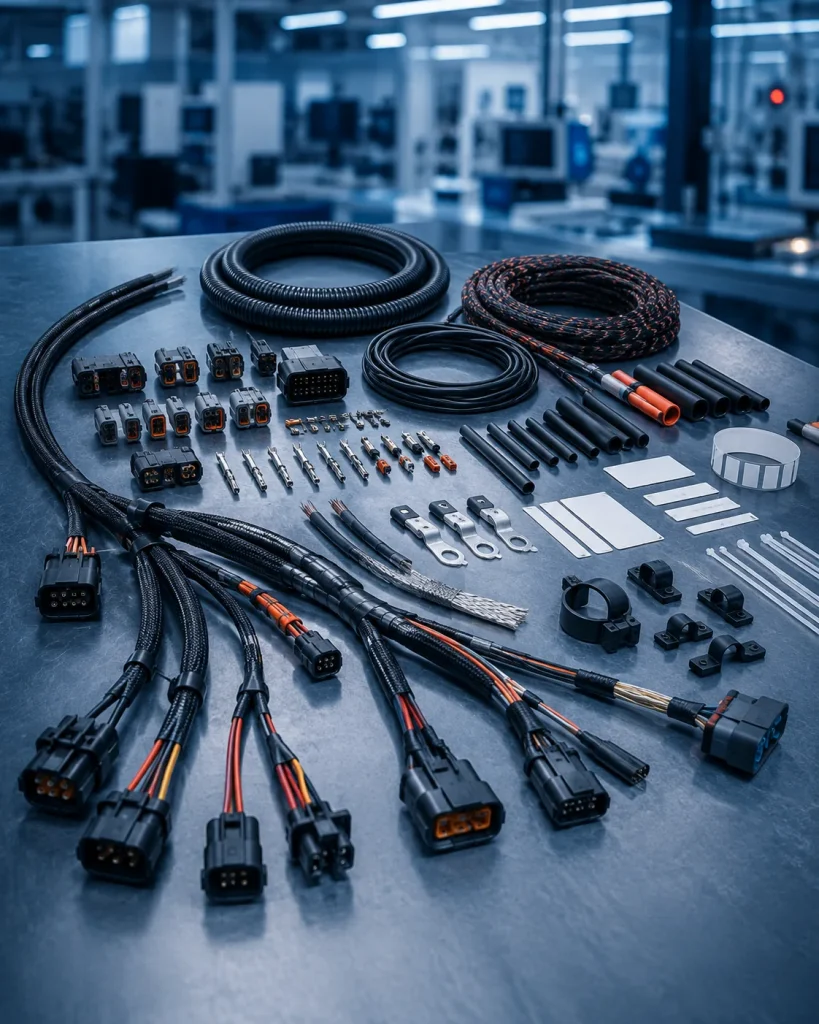
Sleeving Conduit Grommets and Strain Relief
Protection components may include braided sleeving, corrugated tubing, PVC tubing, spiral wrap, heat shrink, metal conduit, grommets, cable glands, boots, tie mounts, clips, strain reliefs and protective covers. The purpose is to protect the harness from abrasion, heat, oil, chemicals, sharp edges, vibration and movement.
Use abrasion protection where cables touch machine frames. Use grommets where cables pass through metal panels. Use strain relief near moving connectors. Use oil-resistant sleeves near lubricated zones. Use heat-resistant protection near motors, heaters or exhaust-related areas. Route the harness away from pinch points, moving chains, belts and sharp brackets.
Routing for Maintainability
Industrial equipment must be serviceable. Good harness routing supports easy installation, clear labels, fast troubleshooting, safe separation from moving parts, service loops, connector access and logical circuit grouping. Maintenance teams should not need to cut cable ties randomly or pull wires aggressively to diagnose a machine problem.
Labels should remain visible after installation. Connectors should be accessible without dismantling unrelated machine sections. Wires should not be forced into tight bends to save space. A neat harness is not only visually better; it reduces service time and field error.
Step 6: Define Testing and Quality Control
Electrical Tests
Common electrical tests include continuity, open circuit, short circuit, miswire, hi-pot, insulation resistance, contact resistance, voltage drop, functional testing and signal testing where needed. Simple continuity testing confirms that circuits are connected, but it may not detect insulation weakness, poor sealing, marginal crimp quality or signal noise risk.
Industrial buyers should define the test level based on application risk. A low-voltage control harness may need continuity, miswire and pull force checks. A higher-voltage power harness may need hi-pot or insulation resistance testing. A washdown harness may need sealing review. A sensor harness may need functional signal validation.
Mechanical and Environmental Tests
Mechanical tests may include pull force, terminal retention, bend testing, vibration review, connector mating test, label adhesion, sleeve position check, dimensional inspection and crimp cross-section review. Environmental checks may include water spray review, heat exposure, cold exposure or oil resistance depending on application.
| Test Type | Purpose | Industrial Use Case |
|---|---|---|
| Continuity | Confirms circuit path | All harnesses |
| Miswire test | Prevents wrong pinout | Multi-connector harnesses |
| Hi-pot | Checks insulation withstand | Higher-voltage equipment |
| Pull force | Confirms crimp strength | Crimped terminals |
| Insulation resistance | Checks leakage risk | Wet or higher-voltage systems |
| Functional test | Verifies application behavior | OEM equipment harnesses |
| Water ingress check | Confirms sealing | Washdown or outdoor machines |
Step 7: Industrial Standards Compliance and Documents
IPC/WHMA-A-620 and Workmanship Acceptance
IPC/WHMA-A-620 is widely used as an acceptance reference for cable and wire harness assemblies. Buyers may use it to define workmanship expectations for wire preparation, crimped terminations, soldered terminations, mechanically secured terminations, lacing, tying, insulation condition and inspection criteria.
However, a workmanship standard does not replace a drawing. The buyer still needs wire lengths, branch lengths, connector part numbers, pinout, sleeve locations, labels, tolerances, test requirements and packaging notes. The strongest industrial harness projects combine a clear engineering drawing with an accepted workmanship standard and supplier process control.
UL RoHS REACH NFPA 79 IEC 60204-1 and Customer Requirements
Industrial buyers may request RoHS declarations, REACH declarations, UL cable information, UL traceability where required, material certificates, certificates of conformity, inspection reports, FAI reports, test records, wire data sheets, connector data sheets, PPAP for automotive-related programs or customer-specific quality documents.
For industrial machinery, buyers may also review NFPA 79 or IEC 60204-1 direction depending on the target market and machine category. These standards do not automatically define every harness detail, but they influence how electrical equipment, documentation, safety circuits and machine wiring requirements are planned.
Step 8: Prototype Validation and Field Testing
First Article Inspection
First Article Inspection should verify drawing revision, wire length, branch length, connector orientation, pinout, label position, sleeve position, crimp quality, continuity, packaging and test records. This step prevents a small prototype issue from becoming a batch-wide production defect.
Buyers should compare the first article with the latest drawing, not with memory or verbal comments. If the harness has changed, the drawing revision must change. Version confusion is one of the most common causes of industrial sourcing disputes.
Installation Fit Test
The sample harness should be installed into the real machine. Check whether it reaches every connection, whether it interferes with moving parts, whether bend radius is acceptable, whether labels remain visible, whether technicians can service it, whether connectors are easy to mate and lock, and whether the route avoids heat, oil, sharp edges and pinch points.
A harness can pass the test bench but fail the machine. Fit testing is the bridge between electrical validation and real industrial reliability.
Pilot Run Before Mass Production
A pilot run validates fixture repeatability, operator instructions, defect rate, test process, packing method, traceability, engineering change handling and batch consistency. For industrial equipment, the pilot stage may also include limited field testing because vibration, oil, heat and movement may not appear during simple bench inspection.
Step 9: Compare Supplier Capability
What an Industrial Custom Wire Harness Factory Should Have
An industrial Custom Wire Harness factory should support wire cutting, stripping, crimping, soldering if needed, overmolding if needed, harness boards, continuity testers, hi-pot testers, pull force testers, crimp height measurement, labeling systems, traceability systems, incoming material inspection, process inspection, final inspection, packaging control and engineering review.
Supplier capability matters because industrial harnesses are not only about assembly labor. The supplier must understand material compatibility, harsh environments, connector sealing, process control, documentation and long-term repeat production. The ability to catch a design risk before sampling is often more valuable than a small price difference.
| Supplier Capability | Why It Matters | Buyer Question |
|---|---|---|
| Engineering review | Prevents design mistakes | Can you review drawings before sampling? |
| Crimp control | Reduces field failure | Do you provide pull force records? |
| Test fixture | Improves repeatability | Is 100% electrical testing available? |
| Material traceability | Supports audits | Can you track wire and connector lots? |
| Industrial experience | Matches harsh applications | What machinery projects have you supported? |
| Documentation | Supports customers | Can you provide RoHS, REACH, COC or FAI? |
| ECO process | Prevents version confusion | How do you control revisions? |
Step 10: Cost Total Value and RFQ Checklist
Why Industrial Harnesses Should Not Be Bought by Price Alone
Industrial harness cost should be measured against machine downtime, service technician travel, warranty replacement, production line stops, field troubleshooting, scrapped assemblies, connector replacement, late delivery, missing documents and engineering change confusion. A cheap harness that fails on a machine may cost far more than a better-designed harness with stronger materials and testing.
Procurement should compare total value: design support, material selection, sample speed, testing level, documentation, traceability, delivery stability, defect response and repeat production consistency. In industrial environments, the cost of failure is usually higher than the cost of specifying the harness correctly.
Buyer RFQ Checklist
| RFQ Item | Why It Matters | Buyer Requirement |
|---|---|---|
| Application | Defines environment risk | Machine type, installation location and working condition |
| Voltage and current | Controls wire and terminal selection | Provide continuous and peak values |
| Environment | Controls materials and protection | Temperature, oil, water, dust, UV, chemicals and vibration |
| Movement condition | Controls flex cable and strain relief | Static, moving, drag chain, robot arm or mobile equipment |
| Connector system | Controls sealing and serviceability | Part numbers, IP rating, locking method and pinout |
| Testing | Prevents hidden defects | Continuity, miswire, hi-pot, pull force, insulation resistance or functional test |
| Documentation | Supports audits and compliance | COC, FAI, RoHS, REACH, UL data, test record or customer forms |
Common Buyer Mistakes
Mistake 1: Using Standard Harnesses in Harsh Industrial Conditions
A standard harness may work during prototype testing but fail early when exposed to heat, oil, vibration, washdown or movement. Buyers should specify the industrial environment clearly instead of assuming the supplier knows the machine conditions.
Mistake 2: Ignoring Connector Sealing
Water ingress and intermittent faults often happen because connector sealing is underestimated. Define IP rating, seal type, cable diameter range and assembly inspection requirements before production.
Mistake 3: Choosing Wire by Gauge Only
Wire gauge controls current capacity, but it does not define flexibility, insulation material, oil resistance, chemical resistance or temperature performance. Select wire by current, environment and routing together.
Mistake 4: No Strain Relief for Moving Parts
Moving parts place stress on wires and connectors. Use flex-rated cable, proper bend radius, clips and strain relief to prevent broken conductors and connector damage.
Mistake 5: No Test Records
Without test records, it is difficult to trace defects, prove quality or isolate batch problems. Industrial buyers should require test reports and batch traceability for critical harnesses.
Industry Trends in Industrial Custom Wire Harnesses
More Automation Equipment Needs Compact Harnesses
Machines are becoming smaller, more modular and more sensor-rich. This creates demand for compact harnesses with tighter routing, smaller connectors, clearer labels and better installation planning.
More Demand for Waterproof and Oil-Resistant Harnesses
Factories increasingly need harnesses that can survive washdown, coolant, lubricants and outdoor humidity. Material selection is becoming more important than wire length alone.
More Shielded Harnesses for Sensors and Drives
Automation systems rely on stable sensor, encoder and communication signals. As equipment adds more motors and drives, shielding and grounding become more important for signal reliability.
More Buyers Request Traceability
OEMs increasingly request wire lot tracking, connector lot tracking, test records, inspection reports and revision control. Traceability supports quality audits, failure analysis and repeat production.
More Supplier Involvement in Early Design
Good suppliers are becoming engineering partners. They help optimize manufacturability, connector choice, sleeve selection, bend radius, crimp design and test requirements before sampling begins.
Final Recommendation: Choose by Industrial Risk Not by Harness Appearance
A Custom Wire Harness for industrial applications should be selected by real working conditions: voltage, current, temperature, oil, water, dust, vibration, movement, connector sealing, shielding, routing, testing and compliance requirements. The harness should be designed to survive the machine, not only to pass a basic bench test.
Before requesting an industrial Custom Wire Harness quote, prepare your machine type, voltage/current, temperature range, oil/water/dust exposure, movement condition, wire type, connector part numbers, pinout, sleeve requirements, IP rating, testing needs, compliance documents, quantity and forecast. A professional industrial cable assembly manufacturer can help match harness design with real industrial reliability needs.
Frequently Asked Questions About Industrial Custom Wire Harnesses
1. What makes a Custom Wire Harness suitable for industrial applications?
A Custom Wire Harness is suitable for industrial applications when it matches the machine’s voltage, current, temperature, vibration, moisture, oil exposure, movement, connector sealing, routing, protection and testing requirements. Industrial harnesses should use appropriate wire insulation, locking connectors, strain relief, protective sleeving, clear labels and controlled crimp quality. The supplier should also provide test records and traceability when the harness is used in critical machinery or OEM production.
2. What wire insulation is best for industrial wire harnesses?
The best insulation depends on the application. PVC may suit general cabinet and machinery wiring. PUR is often useful where abrasion and oil resistance are important. Silicone can support heat and flexibility, while PTFE or FEP may be selected for higher temperature or chemical exposure. XLPE can support stronger heat and abrasion performance than basic general-purpose insulation. Buyers should choose wire by current, temperature, movement, oil exposure and routing conditions, not by gauge alone.
3. How do I choose connectors for an industrial Custom Wire Harness?
Choose industrial connectors by current rating, voltage rating, pin count, IP rating, locking mechanism, temperature range, cable diameter, mating cycles, vibration resistance, field serviceability and availability. For wet, dusty or washdown environments, connector sealing and cable gland compatibility are critical. For vibrating equipment, connector locking and terminal retention are important. Buyers should also confirm lead time and approved alternatives before mass production.
4. What tests should an industrial Custom Wire Harness pass?
Common industrial Custom Wire Harness tests include continuity, open circuit, short circuit, miswire, hi-pot, insulation resistance, pull force, crimp height, terminal retention, connector mating, sleeve position, label adhesion, water ingress review and functional testing. The exact test plan should match the application risk. A simple low-voltage cabinet harness may need fewer tests than a waterproof, high-vibration, high-current or safety-related harness used in machinery.
5. How do I choose a Custom Wire Harness supplier for industrial equipment?
Choose a Custom Wire Harness supplier with engineering review, industrial material knowledge, connector sourcing ability, crimp process control, test fixtures, traceability, documentation support, sample capability and repeat production stability. The supplier should ask about your machine type, voltage, current, temperature, oil and water exposure, vibration, movement, connector system, IP requirement, testing needs and production volume before recommending materials or quoting final pricing.
References
- IPC/WHMA-A-620 Requirements and Acceptance for Cable and Wire Harness Assemblies, Author: IPC and WHMA Technical Committee, Institution: IPC International and WHMA, Source: Cable and Wire Harness Assembly Standard.
- Wiring Harness Traceability Program, Author: UL Solutions Technical Team, Institution: UL Solutions, Source: Wiring Harness Traceability and Cable Sourcing Resource.
- NFPA 79 Electrical Standard for Industrial Machinery, Author: NFPA Technical Committee Contributors, Institution: National Fire Protection Association, Source: Industrial Machinery Electrical Safety Standard.
- IEC 60204-1 Safety of Machinery – Electrical Equipment of Machines, Author: IEC Technical Committee Contributors, Institution: International Electrotechnical Commission, Source: Machinery Electrical Equipment Standard.
- RoHS Directive 2011/65/EU, Author: European Commission Contributors, Institution: European Commission, Source: Electrical and Electronic Equipment Hazardous Substance Regulation.
- REACH Regulation Overview, Author: European Chemicals Agency Contributors, Institution: European Chemicals Agency, Source: EU Chemicals Regulation Reference.
- Industrial Control Panels and Machine Wiring Guidance, Author: Engineering Safety Contributors, Institution: Electrical Safety and Automation Industry Publications, Source: Industrial Electrical Design Reference.
- Quality Management Systems Requirements, Author: ISO Technical Committee Contributors, Institution: International Organization for Standardization, Source: Quality Management Reference.
How Buyers Should Choose a Custom Wire Harness for Industrial Applications
How should buyers start an industrial Custom Wire Harness project?
Buyers should start by describing the machine environment. Voltage and current are important, but industrial reliability also depends on temperature, oil, water, dust, vibration, movement, bend radius, connector sealing, shielding and maintenance access.
Why is the operating environment more important than wire length?
Wire length affects cost and voltage drop, but the operating environment determines whether the harness survives. Heat, oil, washdown, vibration and repeated motion can damage a harness that looks correct on a drawing but uses unsuitable materials.
What option works best for control cabinets?
Control cabinet harnesses usually need clear labeling, organized routing, terminal quality, ferrules where required, documentation and easy troubleshooting. The strongest value is installation speed and service clarity.
What option works best for moving machinery?
Moving machinery needs flex-rated cable, controlled bend radius, abrasion protection, strain relief, secure connectors and routing away from pinch points. A static cable design should not be used in dynamic applications without review.
Consideration: What creates the highest industrial harness failure risk?
The highest risks come from underspecified environments, poor crimp control, weak connector sealing, wrong insulation material, missing strain relief, poor shielding, no test records and uncontrolled drawing revisions.
Recommendation
Select the harness by application risk. Ask the supplier to review materials, connectors, sleeve protection, routing, testing and documentation before sampling. A good supplier reduces downtime risk, not only assembly cost.
Before ordering, send your supplier the drawing, BOM, machine photos, voltage/current data, environmental exposure, movement details, connector part numbers, testing requirements, compliance needs and expected production volume. A professional Custom Wire Harness supplier can recommend a safer and more durable industrial solution.